

 lOG IN





Pichwai & The Tales of Shrinathji
Written by Manasvi Vislot
Views 221
 Published on December 19, 2025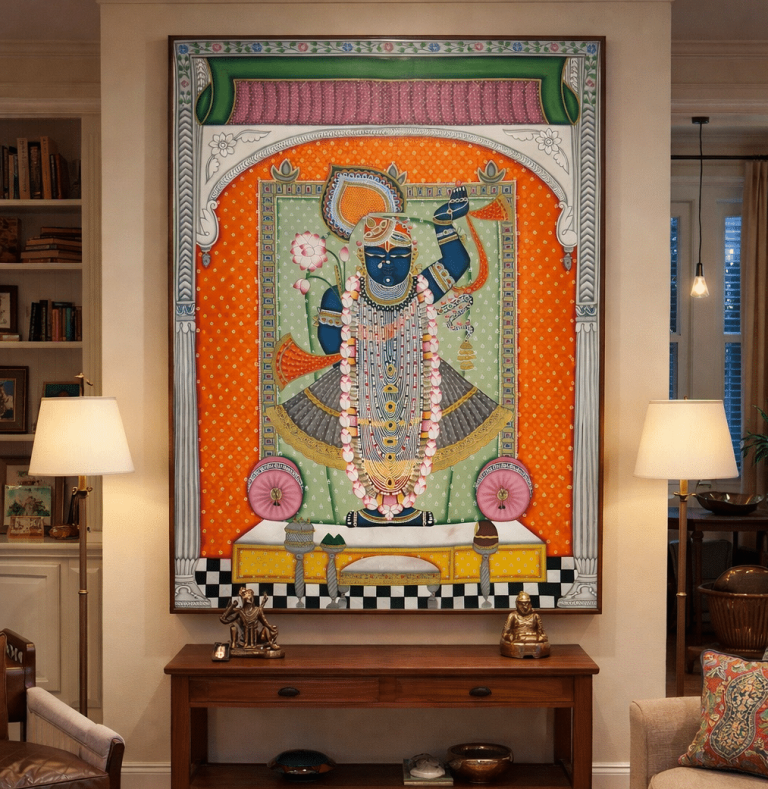
In Part 1, we discovered how Pichwai began in Nathdwara born not just as an art form, but as a way to serve Shrinathji every single day.We explored its origins, its sacred purpose, and how it became the visual heartbeat of the Vallabh Sampradaya. Now, in Part 2, we move deeper into its world. Here, we unfold the tales, meanings, and devotional practices that shaped the early identity of Pichwai and still guide artists today.
Tales of Shrinathji in Pichwai Art
Step closer to a Pichwai painting, and something quietly shifts.The colors soften. The space feels still. And before you realize it, you are no longer just looking at art you are standing in Nathdwara, before Shrinathji, the beloved child form of Krishna. Pichwai does not tell stories loudly. It whispers them. Through stillness, rhythm, and devotion, it captures moments from Shrinathji’s divine life moments not frozen in time, but eternally present for the devotee.
Every Pichwai is not just painted. It is offered.
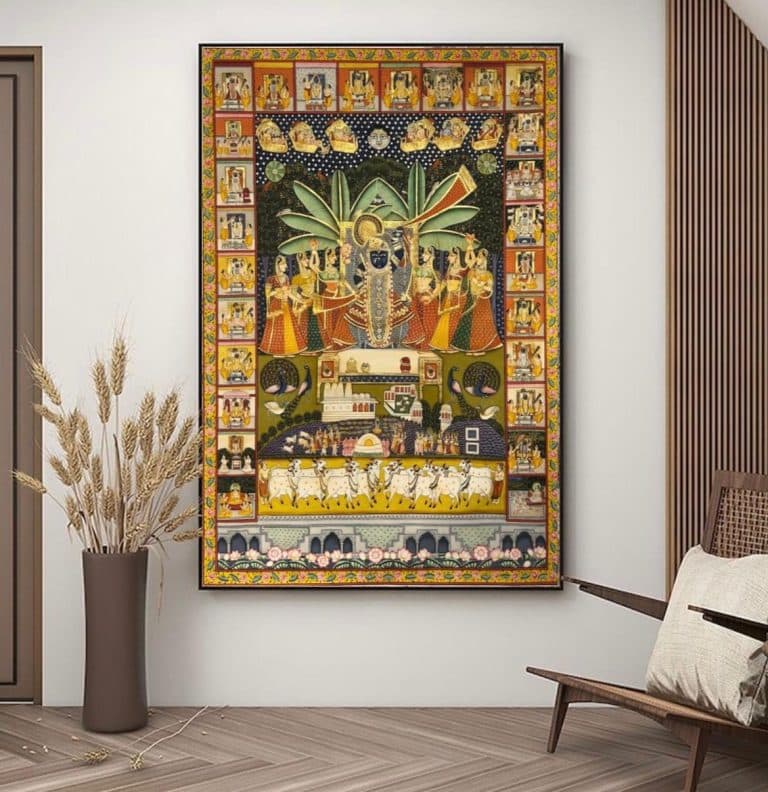
When Shrinathji Lifted Govardhan – Govardhan Leela
The skies darken. The rains pour. Fear spreads through Vraj. In this moment, Shrinathji the young form of Krishna worshipped at Nathdwara lifts Mount Govardhan with effortless grace. In Pichwai, this leela is painted not as power, but as protection. Villagers, cows, and gopis gather beneath the mountain, their faces calm, their hearts trusting. Shrinathji stands serene, smiling gently, assuring them without words. This scene holds deep meaning in the Nathdwara tradition. Govardhan Leela in Pichwai is a reminder that Shrinathji is always watching, always sheltering those who surrender with faith.
The Eternal Dance of Devotion – Raas Leela of Shrinathji
As night falls, the moon rises over Vraj. In Pichwai, Raas Leela is painted as a sacred rhythm Shrinathji dancing with the gopis in perfect harmony. The compositions flow in gentle circles, garments move like music, and the forest glows with divine presence.Shrinathji appears beside every gopi, reminding devotees that his grace reaches each soul equally. This is not merely a dance, but an expression of divine love where devotion dissolves distance. In Nathdwara, Raas Leela is not a story of the past. It is an eternal moment, relived through art and bhakti.
Shrinathji as Gopala – The Beloved Cowherd
Morning light touches the land of Vraj. Pichwai often shows Shrinathji as Gopala barefoot, flute in hand, surrounded by cows who look upon him with deep affection. There is no royal grandeur here, only quiet harmony. Cows in Pichwai are sacred companions, symbols of abundance, gentleness, and devotion. Shrinathji walks among them not as a ruler, but as one who belongs. This leela reflects the Nathdwara belief that divinity lives closest to nature, simplicity, and compassion.
Play on the Yamuna – Nauka Vihar
The Yamuna flows softly. A small boat drifts across the water. In Nauka Vihar, Shrinathji reveals his playful side. He gently rocks the boat, teasing Radha and the gopis. Laughter fills the air. Lotuses bloom. The water sparkles with joy. Pichwai artists paint this leela with lightness and grace, reminding devotees that Shrinathji’s divinity includes joy, play, and warmth. Here, devotion is not solemn it is alive.
The Beloved Child – Bal Leela of Shrinathji
And then, there is the child. Butter on his lips. Mischief in his eyes. Shrinathji as a child steals makhan, plays with friends, and fills every home with laughter. In Bal Leela, Pichwai captures tenderness at its purest. These scenes feel intimate, almost personal as if Shrinathji is not a deity on a pedestal, but a child welcomed into the devotee’s heart. This is the Shrinathji worshipped in Nathdwara a living presence, lovingly served, adorned, and celebrated every day.
Stories That Live Through Seva
Govardhan Leela, Raas Leela, Gopala Leela, Nauka Vihar, and Bal Leela do not end on the canvas. Through Pichwai, they live on in temple sanctums, during daily seva, and within the hearts of devotees. Each painting becomes a doorway into Shrinathji’s world, where every color carries devotion and every scene holds meaning. These are only a few moments from Shrinathji’s divine leelas, lovingly preserved through Pichwai. And as the journey continues, there is still more to discover the rituals that shape his daily seva, the festivals that transform Nathdwara, the techniques behind each painting, the symbolism hidden in every detail, and the way Pichwai continues to live in the modern world.
The Legacy of Pichwai – Part 3
In this part, we will explore the rituals & Pichwai from divine rituals and playful moments to sacred stories that infuse devotion, joy, and emotion . The journey continues beyond these stories.
These sacred stories continue to find resonance beyond temple walls. Today, curated platforms like Elisium Art help preserve and present authentic Pichwai art for a global audience, ensuring that the devotion of Nathdwara travels into modern homes while honoring its spiritual roots.
To experience the complete essence of Pichwai, we invite you to explore the next parts of The Legacy of Pichwai series:
Part 3: Pichwai & Rituals of Lord Krishna
Part 4: Pichwai & Festivals of Lord Krishna
Part 5: Pichwai Artistic Techniques
Part 6: Symbolism in Pichwai
Part 7: Pichwai in Modern Times
Written by
Manasvi Vislot
Manasvi Vislot is an India based creative storyteller at Elisium Art. She blends global art trends with strategic digital insights, crafting content that connects readers with the evolving world of contemporary, digital, and cultural art. With her refined eye for aesthetics and a passion for making art accessible, Manasvi creates narratives that highlight the artists, ideas, and innovations shaping today’s creative landscape.
Most Viewed Artworks Among Our Readers

Whisper of the Tree
36 W x 48 H Inch

The Story of an Owl
36 W x 36 H Inch
Pleasure Goddess
36 W x 48 H Inch

Ganesha
20 W x 24 H Inch

The More I Blossom (Print)
16 W x 20 H Inch

The Story of Peacock
72 W x 36 H Inch