

 lOG IN





Symbolism in Pichwai Art
Written by Manasvi Vislot
Views 202
 Published on December 20, 2025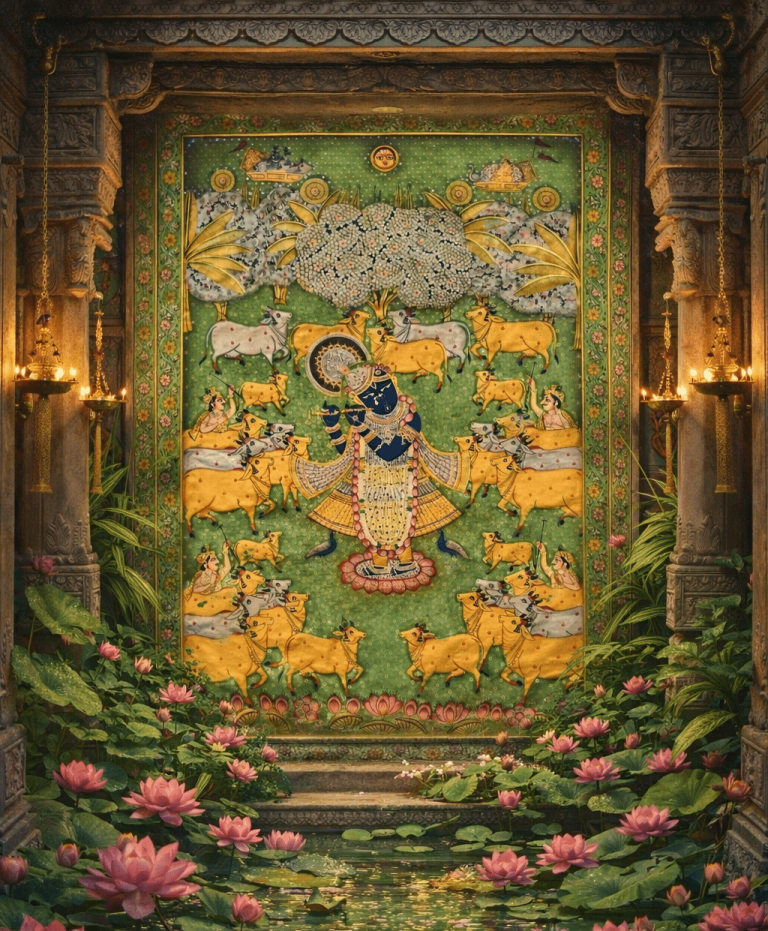
Up to this point, we’ve understood how Pichwai is shaped by rituals, festivals, and time-honoured techniques, each crafted in service to Shrinathji. We’ve seen how artists create not just visuals, but devotional experiences. Now, in Part 6, we look deeper.
This chapter explores the powerful symbolism behind each lotus, cow, moon, tree, and motif revealing the meanings that make every Pichwai more than just art.
Symbolism in Pichwai Art
At first glance, a Pichwai painting feels beautiful. Look a little longer, and it begins to speak. Nothing in Pichwai is placed by chance. Every lotus, every cow, every color and gesture carries meaning. These paintings are not meant to be read quickly — they unfold slowly, revealing layers of symbolism that guide the viewer from the visible to the spiritual. In Pichwai, symbolism is the quiet language through which devotion is expressed.
Shrinathji – The Form of Protection and Grace
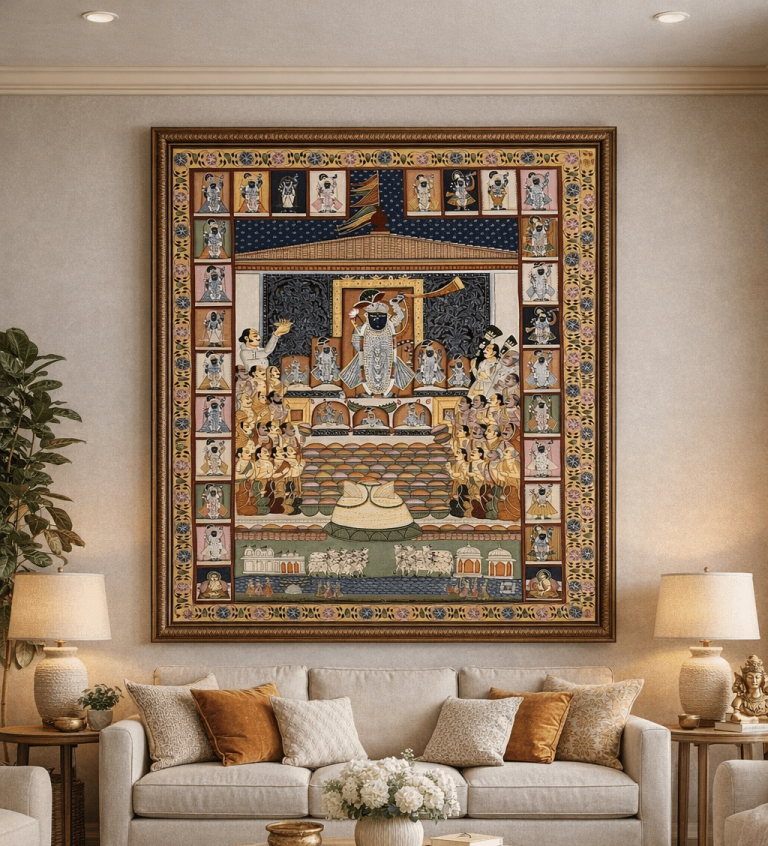
At the center of most Pichwai paintings stands Shrinathji, his left arm raised, his posture calm and steady. This form represents the moment of Govardhan Leela, when Krishna protected his devotees. His stance symbolizes reassurance a reminder that the divine stands as a shield in times of uncertainty. The lifted arm is not forceful; it is gentle, suggesting protection through compassion rather than power.
Lotus – Purity Beyond the World
The lotus appears again and again in Pichwai, blooming beneath Krishna’s feet or floating across ponds. Growing in muddy waters yet untouched by them, the lotus symbolizes purity, detachment, and spiritual awakening. In Pichwai, it reminds devotees to live in the world without being bound by it to remain rooted, yet elevated.
Cows – Innocence and Abundance
Cows are not background elements in Pichwai. They are central figures. They symbolize gentleness, nourishment, and devotion. Often shown gazing toward Krishna, cows represent the ideal devotee calm, trusting, and ever-present. Their presence also reflects abundance and harmony between humanity and nature.
Peacock – Beauty and Divine Play
The peacock, with its iridescent feathers, represents beauty, joy, and Krishna’s playful nature. In Pichwai, peacocks often appear dancing or observing from the edges of the scene, symbolizing celebration and divine pleasure. They remind the viewer that beauty and joy are sacred expressions, not distractions from spirituality.
Colors – Emotion and Time
- Colors in Pichwai carry emotional weight.
- Blue represents infinity, calm, and divinity — reflecting Krishna’s cosmic nature.
- Gold symbolizes purity, light, and sacred presence.
- Green reflects life, renewal, and harmony with nature.
- White evokes peace, serenity, and spiritual clarity.
Flute – The Call of the Divine
Krishna’s flute appears quietly in many Pichwai paintings. It symbolizes the divine call – the unseen force that draws the soul toward Krishna. The flute reminds us that the divine does not command; it invites. It is through love, not force, that devotion flows.
Circular Composition – The Eternal Cycle
Many Pichwai scenes follow a circular or symmetrical layout. This represents eternity the idea that devotion has no beginning or end. The viewer’s gaze moves endlessly within the painting, mirroring the eternal bond between Krishna and his devotees.
Festive Motifs – Time Made Sacred
Seasonal elements moonlight, flowers, lamps, clouds reflect sacred time. They show that every moment, when lived with devotion, becomes worthy of celebration. In Pichwai, time itself is symbolic. Pichwai symbolism is not meant to be decoded like a puzzle. It is meant to be felt. As the viewer understands these symbols, the painting transforms from art to experience, from image to presence. What once felt decorative becomes deeply personal. Even as Pichwai finds new spaces in modern homes and galleries, its symbols remain unchanged. They continue to whisper the same messages of devotion, balance, and grace. To look at a Pichwai painting is to enter a silent conversation one that has been ongoing for centuries, and one that continues every time a viewer pauses to listen. These symbols are not meant to be decoded once and forgotten. They stay with you, revealing new meaning each time you return to the painting. What begins as observation slowly becomes connection a quiet understanding that grows with time. And as these symbols continue to speak, Pichwai itself continues to move forward. Beyond tradition and timeless meaning lies its journey into the present into modern homes, contemporary spaces, and new ways of living with this sacred art.
In this evolving landscape, curated platforms like Elisium Art play a thoughtful role in presenting authentic Pichwai works within refined contemporary settings. Here, the symbolism remains untouched the peacock still celebrates divine play, the gold still carries sacred light while the art finds new audiences who value both heritage and meaning.
We invite you to step into the next part and discover how Pichwai lives and breathes in the modern world.
Part 7: Pichwai in Modern Times
Written by
Manasvi Vislot
Manasvi Vislot is an India based creative storyteller at Elisium Art. She blends global art trends with strategic digital insights, crafting content that connects readers with the evolving world of contemporary, digital, and cultural art. With her refined eye for aesthetics and a passion for making art accessible, Manasvi creates narratives that highlight the artists, ideas, and innovations shaping today’s creative landscape.