


 lOG IN





The Legacy of Pichwai-Part 1
Written by Manasvi Vislot
Views 203
 Published on 18 de diciembre de 2025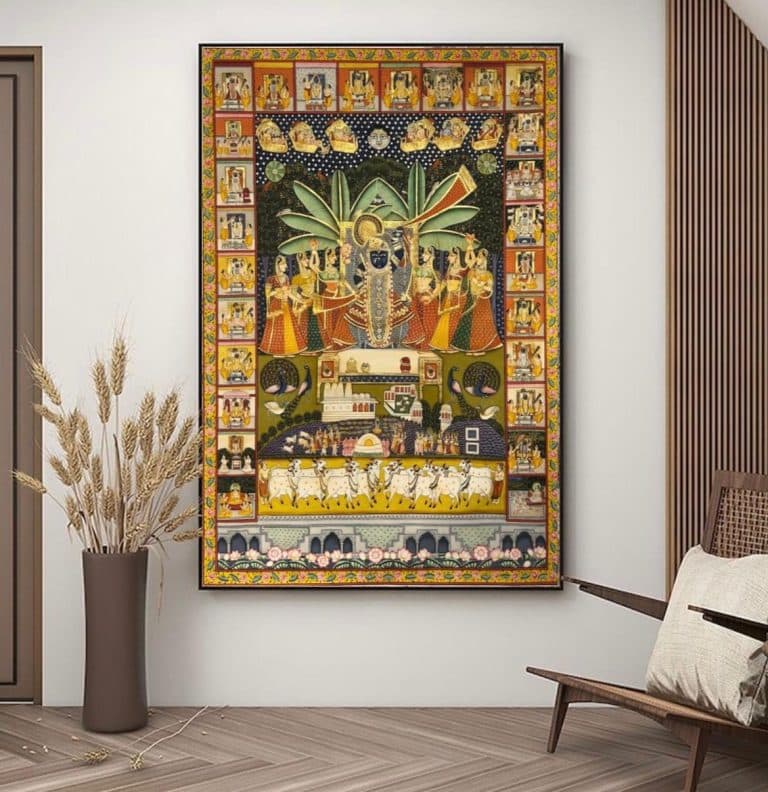
Introduction to Pichwai Art: A Journey Into Devotion, Color & Timeless Indian Craftsmanship
Imagine walking into a dimly lit temple in Nathdwara, Rajasthan. The air smells of incense. Bells ring softly in the background. And right behind the idol of Shrinathji, the child form of Krishna, hangs a giant painting so detailed and vibrant that it feels alive. This painting isn’t just art. It’s a story, a prayer, a celebration, and a piece of India’s living heritage. This is Pichwai Art, one of India’s most divine, intricate, and culturally powerful art forms.
In this blog, we will take you on a journey through the origins, history, devotion, colors, and the heart of Pichwai Shrinathji Himself.
What is Pichwai Art?
Pichwai (pronounced pich-vai) literally means «behind the idol» (from Sanskrit: pichh = behind + wai = textile). These are large devotional paintings created as backdrops in the temples of Nathdwara, the spiritual hub of the Pushtimarg tradition in Rajasthan. But calling Pichwai “just a painting” is an understatement. A Pichwai is a living tapestry of devotion.
It is:
- A visual offering toShrinathji
- A storytelling canvas depicting Krishna’sleelas
- A record of festivals, seasons, and temple traditions
- A bridge between divine energy and human emotion
Every element, from lotus flowers to cows, from moonlit nights to lush gardens, carries spiritual meaning. These artworks are so intricate that one Pichwai can take months or even a year to complete, often requiring teams of master artists. Pichwai is, truly, one of the world’s greatest devotional art forms.
Why Pichwai Is Culturally & Artistically Important
Pichwai stands at the intersection of faith, heritage, craftsmanship, and cultural storytelling.
- It preserves centuries-old Vaishnavite rituals.
- It keeps alive traditional painting skills passed down through generations.
- It captures India’s rich aesthetic language, vibrant colors, nature motifs, and symbolism.
- It connects devotees emotionally to the divine form of Krishna.
Even today, these artworks are displayed in modern homes, galleries, and museums across the world, from Mumbai to New York, making Pichwai a global cultural treasure.
Historical Background of Pichwai Art
To understand Pichwai, we must travel back to the 17th century, when the town of Nathdwara became the epicenter of Krishna worship.
Birth of Pichwai in Nathdwara
Around the late 1600s, the idol of Shrinathji was shifted from Govardhan to Nathdwara to protect it from Mughal invasion. With this move, the priests, devotees, and artists settled in this new town.
They needed a way to:
- Decorate the temple
- Create visual representations of daily rituals
- Mark festivals
- Express devotion in artistic form
Thus, Pichwai was born.
Role of the Vaishnavite Sect Pushtimarg
Pichwai is deeply rooted in Pushtimarg, a sect founded by Vallabhacharya. This tradition emphasizes:
- Personal, intimate relationship with Krishna
- Daily ritual worship (seva)
- Artistic expression as devotion
In Pushtimarg, art is not decoration; it is bhakti (devotion).
Royal & Temple Patronage
Pichwai blossomed because it was supported by:
- Temple priests
- Kings and royal families
- Wealthy patrons
This patronage allowed artists to refine the style, evolve new motifs, and keep the tradition alive.
Evolution Through Centuries
Originally, Pichwais were painted for temples.
But over time:
- Travelers carried them to other states
- Collectors discovered them
- Art galleries beganshowcasingthem
- Contemporary artists modernized the style
Today, platforms like Elisium Art play an important role in bringing authentic Pichwai to global audiences, bridging temple tradition with refined contemporary spaces while preserving its devotional soul. Pichwai exists in both traditional and modern forms, yet it never loses its devotional essence.
Shrinathji – The Heart & Soul of Pichwai
You cannot talk about Pichwai without talking about Shrinathji.
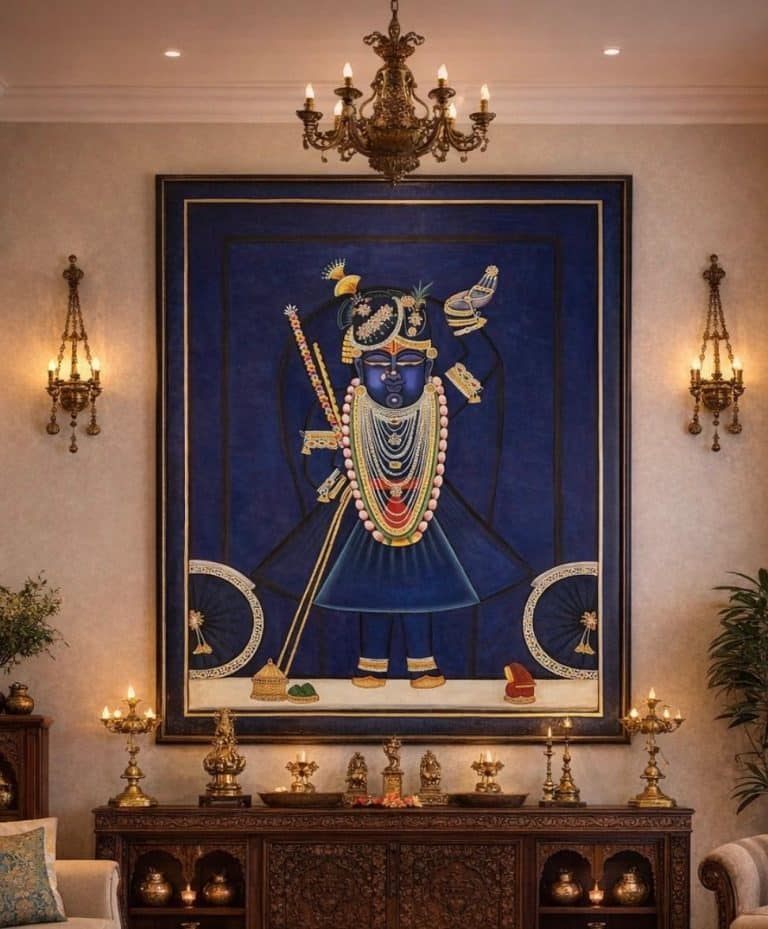
Shrinathji is one of those divine forms that you can’t forget once you’ve seen Him. In every Pichwai, He stands there as a charming young Krishna glowing with innocence, jewels sparkling, clothes painted with divine precision. His left arm is raised high, holding up Mount Govardhan, while His right hand rests confidently on His waist. It’s a pose that feels powerful and playful at the same time. And this exact moment, frozen in divine beauty, is what every Pichwai artist tries to capture. They don’t just paint Him; they bring Him alive.
But why is Pichwai all about Shrinathji and not every form of Krishna? Because Nathdwara is His world, His home, His temple, His playground. Artists grow up hearing the temple bells, smelling the incense, watching priests dress Him every morning, and celebrating every festival with Him. They witness His day unfold like a story: waking at Mangla, being adorned during Shringar, enjoying His grand meal at Rajbhog, and resting peacefully at Utthapan. Each moment becomes inspiration. Each detail becomes a painting. They don’t need references; they’ve lived these scenes their whole life.
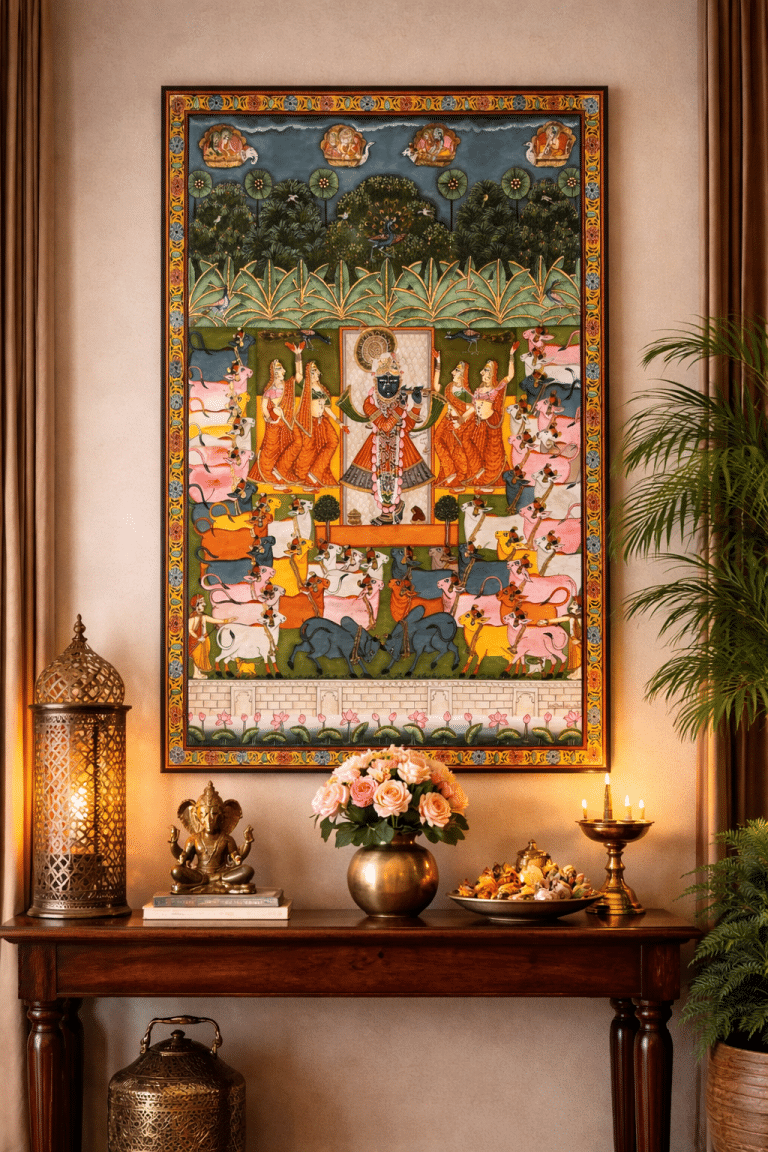
This is why every Pichwai feels like a diary entry of devotion. Artists carefully observe everything: the colors of His garments, the food offered that day, the season outside, and even how the cows or lotuses would look around Him. They turn these tiny rituals into larger-than-life paintings that feel both intimate and grand. And then comes the magic: Pichwai blends devotion, storytelling, and symbolism into one powerful experience. Every stroke is a prayer. Every lotus means purity. Every cow expresses unconditional devotion. The peacock signals monsoon joy. The moon hints at Krishna’s romantic, calm presence. Nothing is random; everything is intentional.
Maybe that’s why Pichwai attracts everyone today: believers, art lovers, collectors, designers. It’s not just an artwork; it’s emotion on canvas. It brings peace, divinity, and an instant sense of history to any space. Whether placed in a pooja room in Jaipur or an ultra–modern apartment in New York, a Pichwai painting doesn’t just hang on the wall. At Elisium Art, this timeless tradition finds a curated global stage, where sacred heritage meets thoughtful curation for collectors and modern connoisseurs alike.
It starts a conversation.
It tells a story.
And most importantly
It makes you feel something.
Pichwai is more than an art form; it is a spiritual experience, an unfolding story, a connection to Krishna, and a celebration of Indian culture. From the temples of Nathdwara to modern homes around the world, its beauty continues to inspire devotion, wonder, and a sense of sacred belonging. We hope you enjoyed reading the first part of The Legacy of Pichwai and discovering its origins and spiritual essence. This introduction is just the beginning of a much deeper journey into one of India’s most revered art forms. There are many more layers of Pichwai waiting to be explored. Continue the series to uncover its stories, rituals, symbolism, and evolving presence in the modern world.
Explore the next parts of The Legacy of Pichwai:
- Part 2: Pichwai & the Tales of Shrinathji
- Part 3: Pichwai & the Rituals of Shrinathji
- Part 4: Pichwai & the Festivals of Shrinathji
- Part 5: Pichwai Artistic Techniques
- Part 6: Symbolism in Pichwai Art
- Part 7: Pichwai in Modern Times
Escrito por
Manasvi Vislot
Manasvi Vislot is an India based creative storyteller at Elisium Art. She blends global art trends with strategic digital insights, crafting content that connects readers with the evolving world of contemporary, digital, and cultural art. With her refined eye for aesthetics and a passion for making art accessible, Manasvi creates narratives that highlight the artists, ideas, and innovations shaping today’s creative landscape.
Las obras más vistas entre nuestros lectores

The Story of an Owl
36 W x 36 H Inch
Pleasure Goddess
36 W x 48 H Inch

Ganesha
20 W x 24 H Inch

The More I Blossom (Print)
16 W x 20 H Inch

The Story of Peacock
72 W x 36 H Inch

The Story of a City
48 W x 36 H Inch